



Objave
In Memoriam Béla Tarr (1955–2026)
Tarr was also a great friend of the Sarajevo Film Festival: in 2006, the Festival dedicated its “Tribute to” programme to him. He was the recipient of the Honorary Heart of Sarajevo at the 19th Sarajevo Film Festival (2013), and in 2014 he served as President of the Jury
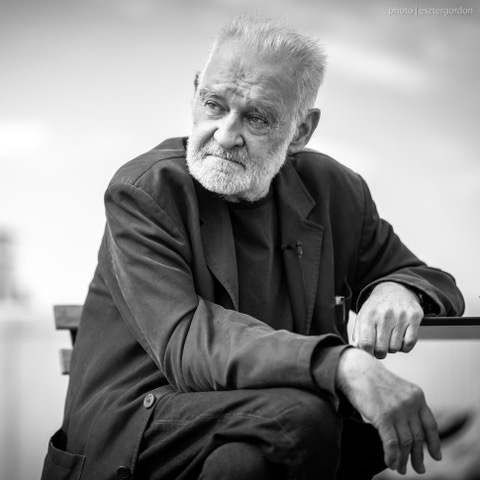
We are left with unforgettable memories of Béla Tarr (1955–2026), one of the most original and important filmmakers of our time. Tarr was also a great friend of the Sarajevo Film Festival: in 2006, the Festival dedicated its “Tribute to” programme to him. He was the recipient of the Honorary Heart of Sarajevo at the 19th Sarajevo Film Festival (2013), and in 2014 he served as President of the Jury.
At the 25th Sarajevo Film Festival (2019), 25 years after its premiere, a digitally restored version of his seven-hour masterpiece SÁTÁNTANGÓ was screened. The film is an adaptation of the novel by László Krasznahorkai, last year’s Nobel Prize laureate in Literature, with whom Tarr had collaborated since the mid-1980s. Tarr attended the screening and, in the early morning hours, shared his experiences of working on the film with the audience in a packed Meeting Point Cinema, where audience had stayed throughout the entire night-long screening. In Sarajevo, Tarr also worked on the long-term educational project film.factory, in partnership with the Sarajevo Film Festival and Meeting Point Cinema.
He will always remain in our hearts.
Béla Tarr was born in 1955, in Pécs, Hungary. He began his career at sixteen as an amateur filmmaker. Later, he worked at Balázs Béla Stúdió, the most important workshop of Hungarian experimental film, where he made his feature directorial debut, Family Nest (1977).
Tarr's first job after high school was as a worker at a shipyard. Two years later, he became a receptionist at a cultural centre while pursuing filmmaking. At the time of winning the Grand Prix at the Mannheim Film Festival for Family Nest, he enrolled in the Academy of Theatre and Film (Színház- és Filmművészeti Egyetem) in Budapest, graduating in 1982. In 1982 he became one of the founders of Társulás Filmstúdió where he worked until the studio was closed for political reasons in 1985. In 1985 he started working as an independent filmmaker. He made the first Hungarian independent film Damnation (1987), which premiered at the Berlin Film Festival in 1988 with great success. In 1989 and 1990, he lived in Berlin as a guest of the DAAD Berliner Künstlerprogram and started his engagement as a visiting professor at the DFFB in Berlin, which he continued until 2011.
Tarr became a member of the European Film Academy in 1997. In 2003 he founded TT Filmműhely, an independent film workshop he led until 2011. TT Filmműhely produced his latest films while Tarr also acted as a producer on other remarkable filmmakers' movies (Miklos Jancsó, Kornel Mundruczó, Benedek Fliegauf, Márta Mészáros et al.).
After announcing his feature film Turin Horse to be his last one (2011, Berlinale Jury Grand Prix), Tarr declared his oeuvre complete and thus decided to dedicate the new part of his career to developing new ways of filmmaking through educational programs for your filmmakers.
The international film school film.factory in Sarajevo was founded by Tarr in 2012. He was the designer and head of the programme (BA, MA and DLA) and professor till 2016, as well as manager of the team. Lauded as one of the most exciting film schools in the world, it has practiced an unconventional and open study format with renowned international film artists as teachers (Apichatpong Weerasethakul, Carlos Reygadas, Pedro Costa, Gus van Sant, Tilda Swinton, Juliette Binoche, Jacques Rancière, and others), and with students coming from all over the world. Films of film.factory students were shown and awarded at numerous festivals (including Cannes, Berlin, Rotterdam, Venice, and others).
During the past years, Tarr has been a visiting professor at several film academies (including Filmakademie BW Ludwigsburg, Le Fresnoy - Studio national des arts contemporains Lille, and FreeSzfe Budapest) and has run workshops and masterclasses for young filmmakers all over the world.
Besides the educational work, he has continued to develop his artistic projects in media beyond or in an expanded film form. In 2017 at Eye Filmmuseum, Amsterdam, he developed an exhibition, Till the End of the World, a cross between a film, a theatre set and an installation, seen by 40.000 visitors. Commissioned by the Wiener Festwochen, in 2019 he authored Missing People, a site-specific project created at the intersection between performance, installation, and motion picture, involving 250 Viennese homeless people.
He is the honorary president of the Hungarian Filmmakers' Association and a member of the Széchenyi Academy of Letters and Arts. Tarr has been given the most prestigious Hungarian prize for artists, the Kossuth Prize and the Hungarian prize for filmmakers, Balázs Béla Prize. He was named a Chevalier dans l'Ordre des Arts et Lettres and was honoured with several remarkable national, international awards, honorary doctorates and life achievement awards (including Honorary Professor - Beijing Film Academy, Honorary medal - Wuhan University, Honorary Fellow - Plymouth College of Art, Magister Artium Gandensis - KASK Ghent, Honorary Doctorate at FAMU Prague, etc.)
In 2019, the Berlinale Forum initiated the worldwide celebration of the 25th anniversary of his magnum-opus Sátántangó, which was chosen as one of the 50 greatest films of all time in the 2012 BFI's Sight and Sound poll. In 2023 he received the Honorary Award of the European Film Academy.